Introduction
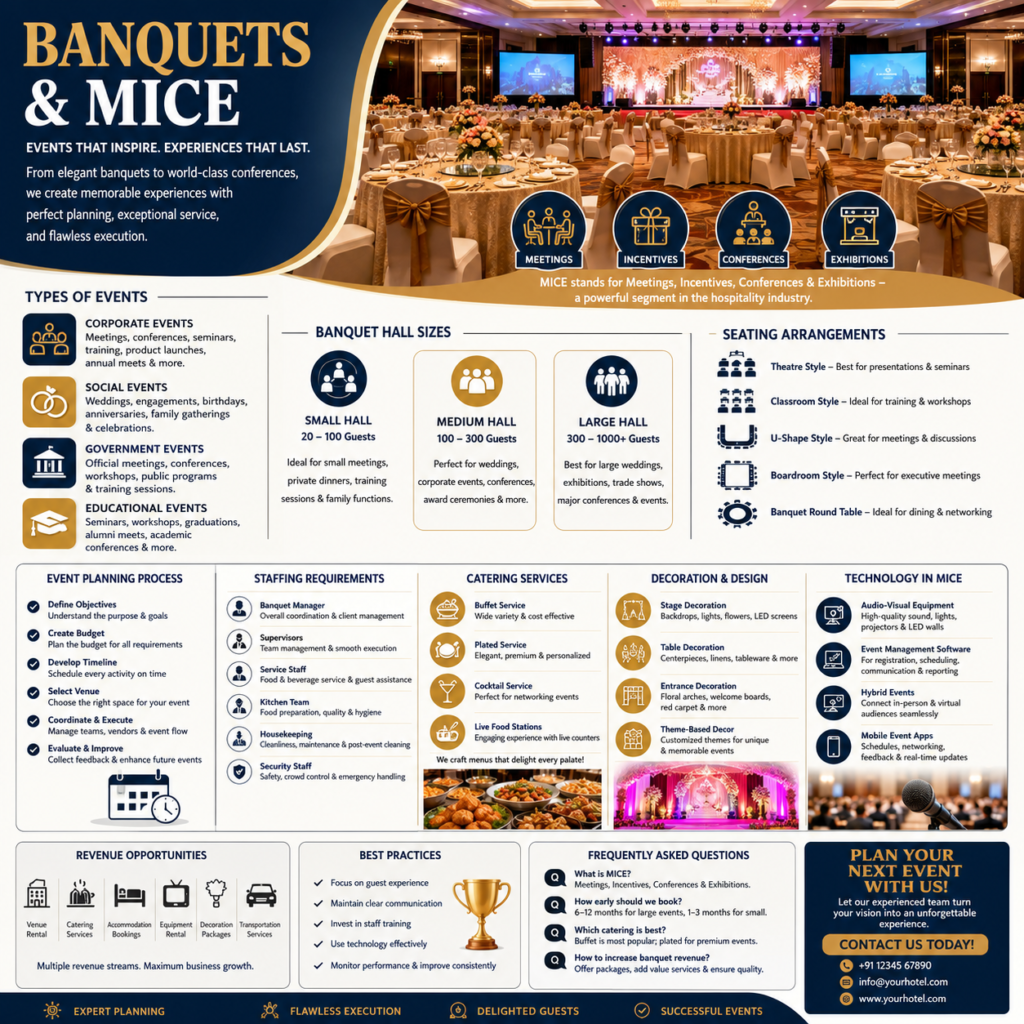
The hospitality industry is no longer limited to hotel rooms and restaurants. Today, Banquets & MICE (Meetings, Incentives, Conferences, and Exhibitions) have become one of the most profitable segments for hotels, resorts, convention centers, clubs, and event venues. Businesses, organizations, government departments, educational institutions, and individuals regularly organize meetings, conferences, weddings, exhibitions, product launches, corporate gatherings, and social celebrations.
A well-managed banquet and MICE operation generates substantial revenue while enhancing a property’s reputation. From venue selection and event planning to catering, staffing, decoration, and guest management, every detail plays a critical role in creating memorable experiences.
This comprehensive guide explains everything about Banquets & Booking, including banquet sizes, booking, event planning, Guest Handling, staffing requirements, Indoor and Out door party, catering services, decorations, technology integration, revenue opportunities, and best practices.
What is Banquet Management?
A banquet is a specially organized event where food, beverages, and hospitality services are provided to a group of guests for a particular occasion.
Common banquet events include:
- Weddings
- Engagement ceremonies
- Birthday parties
- Anniversary celebrations
- Corporate dinners
- Award ceremonies
- Charity events
- Product launches
- Cultural programs
- Social gatherings
Banquet management involves planning, organizing, coordinating, and executing these events while ensuring guest satisfaction and operational efficiency.
What is MICE in Hospitality?
MICE stands for:
M – Meetings
Business meetings conducted by companies, organizations, and institutions.
I – Incentives
Reward trips or events organized by companies for employees, dealers, distributors, or partners.
C – Conferences
Professional gatherings focused on education, networking, discussions, and knowledge sharing.
E – Exhibitions
Trade shows, expos, product displays, and industry showcases where businesses promote their products and services.
Importance of Banquets & MICE in Hospitality
Hotels and resorts increasingly depend on banquet and MICE business because it offers multiple revenue streams.
Benefits include:
- Higher occupancy rates
- Increased food and beverage sales
- Brand visibility
- Corporate partnerships
- Repeat business opportunities
- Improved guest loyalty
- Enhanced market reputation
- Additional income from venue rentals
A successful conference can generate revenue from accommodation, catering, transportation, audiovisual equipment, and event management services simultaneously.
Types of Banquet Events
Corporate Events
Corporate functions are among the most profitable banquet events.
Examples include:
- Business meetings
- Board meetings
- Team-building events
- Corporate training sessions
- Product launches
- Annual meetings
These events require professional service, modern technology, and efficient event coordination.
Social Events
Social events focus on personal celebrations.
Examples include:
- Weddings
- Birthday parties
- Baby showers
- Family reunions
- Anniversary celebrations
Guests expect excellent food, beautiful decoration, and personalized service.
Government Events
Government departments often organize:
- Official meetings
- Conferences
- Training workshops
- Public programs
These events require strict protocols and high organizational standards.
Educational Events
Educational institutions frequently organize:
- Seminars
- Workshops
- Graduation ceremonies
- Alumni meetings
- Academic conferences
Such events require seating arrangements, presentation equipment, and catering services.
Understanding Banquet Hall Sizes
One of the most important factors in event planning is selecting the appropriate venue size.
Small Banquet Hall
Capacity: 20–100 Guests
Suitable for:
- Family functions
- Small meetings
- Private dinners
- Training sessions
Advantages:
- Lower cost
- Personalized atmosphere
- Easier management
Medium Banquet Hall
Capacity: 100–300 Guests
Suitable for:
- Weddings
- Corporate events
- Conferences
- Award ceremonies
Advantages:
- Flexible layouts
- Better guest flow
- Professional environment
Large Banquet Hall
Capacity: 300–1000+ Guests
Suitable for:
- Large weddings
- Exhibitions
- Trade shows
- Major conferences
Advantages:
- Higher revenue potential
- Large-scale event opportunities
- Greater brand visibility
Banquet Layout and Seating Arrangements
The seating arrangement affects guest comfort and event success.
Theatre Style
Guests sit in rows facing a stage.
Best for:
- Conferences
- Presentations
- Seminars
Classroom Style
Tables and chairs arranged like a classroom.
Best for:
- Training sessions
- Educational programs
U-Shape Style
Tables arranged in a U shape.
Best for:
- Meetings
- Discussions
- Workshops
Boardroom Style
Large table arrangement.
Best for:
- Executive meetings
- Corporate discussions
Banquet Round Table Style
Round tables for dining and networking.
Best for:
- Weddings
- Gala dinners
- Social functions
Venue Booking Process
A systematic booking process helps prevent misunderstandings and operational issues.
Initial Inquiry
Understand client requirements:
- Event type
- Number of guests
- Budget
- Date
- Special requests
Site Inspection
Show clients:
- Hall size
- Facilities
- Parking
- Guest rooms
- Catering options
Proposal Preparation
Provide detailed information regarding:
- Venue rental
- Food packages
- Decoration costs
- Equipment charges
- Additional services
Contract Signing
The agreement should clearly mention:
- Payment terms
- Cancellation policies
- Event schedule
- Service inclusions
Advance Payment
Advance deposits secure the booking and reduce financial risks.
Event Planning Process
Successful events require detailed planning.
Define Objectives
Determine:
- Purpose of the event
- Target audience
- Expected outcomes
Create Budget
Budget categories include:
- Venue
- Catering
- Decoration
- Entertainment
- Staffing
- Technology
Develop Timeline
A timeline ensures all activities are completed on schedule.
Include:
- Vendor confirmations
- Decoration setup
- Guest registration
- Event execution
Risk Assessment
Identify possible challenges such as:
- Technical failures
- Weather conditions
- Staff shortages
- Transportation issues
Prepare backup plans accordingly.
Banquet Staffing Requirements
Professional staffing significantly influences guest satisfaction.
Banquet Manager
Responsibilities:
- Event coordination
- Client communication
- Staff supervision
- Problem resolution
Banquet Supervisors
Responsibilities:
- Team management
- Service monitoring
- Event execution
Service Staff
Responsibilities:
- Food service
- Beverage service
- Guest assistance
Kitchen Team
Responsibilities:
- Food preparation
- Quality control
- Hygiene compliance
Housekeeping Staff
Responsibilities:
- Venue cleanliness
- Washroom maintenance
- Post-event cleaning
Security Personnel
Responsibilities:
- Crowd management
- VIP protection
- Emergency response
Catering Services in Banquets
Food quality often determines event success.
Buffet Service
Most popular banquet catering style.
Advantages:
- Variety of dishes
- Faster service
- Cost-effective
Plated Service
Food served individually.
Advantages:
- Elegant presentation
- Controlled portions
- Premium experience
Cocktail Service
Suitable for networking events.
Includes:
- Finger foods
- Canapés
- Beverages
Live Food Stations
Increasingly popular for weddings and exhibitions.
Examples:
- Pasta stations
- Barbecue stations
- Chaat counters
- Dessert counters
Menu Planning for Banquets
A balanced menu should include:
Appetizers
- Soups
- Salads
- Starters
Main Course
- Vegetarian options
- Non-vegetarian options
- Rice
- Bread
Desserts
- Cakes
- Ice cream
- Traditional sweets
Beverages
- Mocktails
- Juices
- Tea and coffee
Menu planning should consider dietary preferences, cultural requirements, and guest demographics.
Decoration and Event Design
Decoration creates the visual identity of an event.
Stage Decoration
The stage is usually the focal point of the venue.
Important elements:
- Backdrops
- Floral arrangements
- LED screens
- Lighting
Table Decoration
Includes:
- Centerpieces
- Linen
- Tableware
- Candles
Entrance Decoration
First impressions matter.
Popular options:
- Floral arches
- Welcome boards
- Red carpet arrangements
Theme-Based Decoration
Examples:
- Luxury weddings
- Corporate branding themes
- Cultural themes
- Seasonal themes
Technology in Modern MICE Events
Technology has transformed event management.
Audio-Visual Equipment
Includes:
- Microphones
- Speakers
- Projectors
- LED walls
Event Management Software
Helps manage:
- Registrations
- Attendance
- Scheduling
- Communication
Hybrid Events
Hybrid events combine physical and virtual participation.
Benefits:
- Wider audience reach
- Cost efficiency
- Greater flexibility
Mobile Event Applications
Provide:
- Event schedules
- Networking opportunities
- Feedback collection
Revenue Opportunities in Banquets & MICE
Hotels can generate revenue from multiple sources.
Venue Rental
Primary income source.
Catering Revenue
Food and beverage sales often contribute significantly to profits.
Accommodation Sales
Many event attendees require overnight stays.
Equipment Rental
Income from projectors, sound systems, and lighting.
Decoration Services
Customized event design packages increase profitability.
Transportation Services
Airport transfers and local transportation create additional revenue streams.
Common Challenges in Banquet & MICE Operations
Last-Minute Changes
Clients may request changes shortly before events.
Staffing Shortages
Adequate workforce planning is essential.
Budget Constraints
Balancing quality and cost can be challenging.
Technical Issues
Equipment failures can disrupt events.
Guest Expectations
High expectations require exceptional service delivery.
Proper planning minimizes these risks.
Best Practices for Successful Banquets & MICE Events
Focus on Guest Experience
Guest satisfaction should remain the highest priority.
Maintain Clear Communication
Keep clients informed throughout the planning process.
Invest in Staff Training
Well-trained employees deliver superior service.
Use Technology Effectively
Modern technology improves efficiency and guest engagement.
Monitor Event Performance
Collect feedback and identify improvement opportunities.
Future Trends in Banquets & MICE Industry
The industry continues evolving rapidly.
Emerging trends include:
- Sustainable event planning
- Eco-friendly catering
- Digital registration systems
- Artificial Intelligence integration
- Hybrid conferences
- Personalized guest experiences
- Contactless technology
- Data-driven event management
Organizations adopting these innovations gain competitive advantages.
Conclusion
Banquets & MICE represent one of the most valuable business opportunities in the hospitality industry. Whether organizing a wedding, corporate conference, exhibition, incentive program, or social celebration, success depends on careful planning, professional staffing, quality catering, attractive decoration, and excellent guest service.
Hotels and event venues that invest in skilled event management, modern technology, customer-focused services, and operational excellence can build a strong reputation while generating significant revenue. As the demand for corporate events, destination weddings, conferences, and exhibitions continues to grow, Banquets & MICE will remain a major driver of hospitality industry success.
Frequently Asked Questions (FAQs)
1. What does MICE stand for in hospitality?
MICE stands for Meetings, Incentives, Conferences, and Exhibitions. It refers to business-related events and tourism activities organized by companies and organizations.
2. What is the ideal banquet hall size for a wedding?
The ideal size depends on guest count. Small halls suit up to 100 guests, medium halls accommodate 100–300 guests, and large halls can host more than 300 guests.
3. Why is banquet staffing important?
Professional staff ensure smooth event execution, quality service, guest satisfaction, and efficient operations.
4. What catering style is best for banquet events?
Buffet service is the most popular because it offers variety and flexibility, but plated service is preferred for premium events.
5. How can hotels increase banquet revenue?
Hotels can increase revenue through venue rentals, catering services, room bookings, equipment rentals, decoration packages, and transportation services.
6. What technology is commonly used in MICE events?
Popular technologies include LED screens, projectors, event management software, mobile event apps, registration systems, and hybrid event platforms.
7. How far in advance should a banquet venue be booked?
Large events and weddings should ideally be booked 6–12 months in advance, while smaller events may require 1–3 months of planning.
8. What is the difference between a banquet and a conference?
A banquet primarily focuses on dining and celebrations, while a conference focuses on professional discussions, presentations, and networking.
Should You Hire a Banquet & MICE Management Team? (Right or Wrong)
✅ Right to Hire Professionals When:
- The event involves more than 100 guests.
- Corporate clients require professional execution.
- Multiple vendors need coordination.
- High-value weddings or conferences are involved.
- Technology and logistics are complex.
❌ Wrong to Ignore Professional Support When:
- You lack event planning experience.
- Budget management is weak.
- Guest expectations are high.
- Tight timelines are involved.
- Risk management is important.
Professional event management often saves time, reduces stress, improves guest satisfaction, and prevents costly mistakes.
Call to Action
Are you planning a wedding, corporate conference, exhibition, incentive trip, banquet event, or large-scale celebration? Professional Banquets & MICE management can transform your vision into a successful and memorable event. From venue selection and booking to staffing, catering, decoration, guest management, and event execution, expert support ensures flawless results.
Need professional Banquet & MICE solutions for your hotel, resort, conference center, or event venue? Contact an experienced hospitality consultant today and create unforgettable events that delight guests and maximize business revenue.