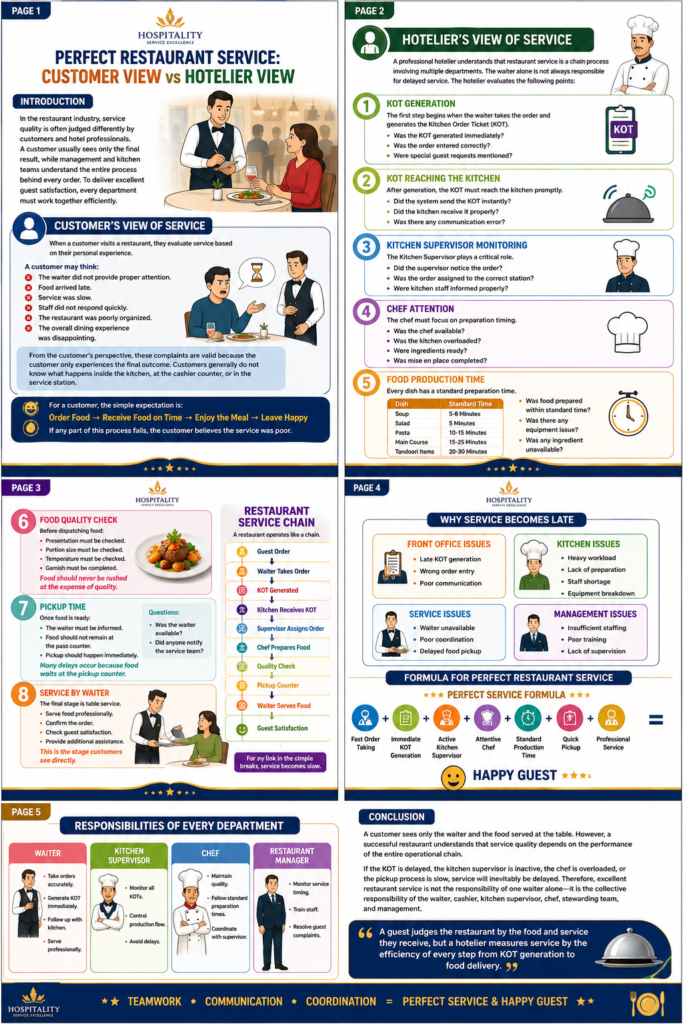
Introduction
In the restaurant industry, service quality is often judged differently by customers and hotel professionals. A customer usually sees only the final result, while management and kitchen teams understand the entire process behind every order. To deliver excellent guest satisfaction, every department must work together efficiently.
Customer’s View of Service
When a customer visits a restaurant, they evaluate service based on their personal experience.
A customer may think:
- The waiter did not provide proper attention.
- Food arrived late.
- Service was slow.
- Staff did not respond quickly.
- The restaurant was poorly organized.
- The overall dining experience was disappointing.
From the customer’s perspective, these complaints are valid because the customer only experiences the final outcome. Customers generally do not know what happens inside the kitchen, at the cashier counter, or in the service station.
For a customer, the simple expectation is:
Order Food → Receive Food on Time → Enjoy the Meal → Leave Happy
If any part of this process fails, the customer believes the service was poor.
Hotelier’s View of Service
A professional hotelier understands that restaurant service is a chain process involving multiple departments.
The waiter alone is not always responsible for delayed service.
The hotelier evaluates the following points:
1. KOT Generation
The first step begins when the waiter takes the order and generates the Kitchen Order Ticket (KOT).
Questions:
- Was the KOT generated immediately?
- Was the order entered correctly?
- Were special guest requests mentioned?
Any delay at this stage affects the entire service process.
2. KOT Reaching the Kitchen
After generation, the KOT must reach the kitchen promptly.
Questions:
- Did the system send the KOT instantly?
- Did the kitchen receive it properly?
- Was there any communication error?
A delay of even 2-3 minutes can impact service speed.
3. Kitchen Supervisor Monitoring
The Kitchen Supervisor plays a critical role.
Responsibilities include:
- Monitoring all incoming orders.
- Prioritizing urgent orders.
- Coordinating chefs and cooks.
- Ensuring food preparation starts immediately.
Questions:
- Did the supervisor notice the order?
- Was the order assigned to the correct station?
- Were kitchen staff informed properly?
4. Chef Attention
The chef must focus on preparation timing.
Questions:
- Was the chef available?
- Was the kitchen overloaded?
- Were ingredients ready?
- Was mise en place completed?
Without proper preparation, food production slows down.
5. Food Production Time
Every dish has a standard preparation time.
Examples:
| Dish | Standard Time |
|---|---|
| Soup | 5-8 Minutes |
| Salad | 5 Minutes |
| Pasta | 10-15 Minutes |
| Main Course | 15-25 Minutes |
| Tandoori Items | 20-30 Minutes |
Questions:
- Was food prepared within standard time?
- Was there any equipment issue?
- Was any ingredient unavailable?
6. Food Quality Check
Before dispatching food:
- Presentation must be checked.
- Portion size must be checked.
- Temperature must be checked.
- Garnish must be completed.
Food should never be rushed at the expense of quality.
7. Pickup Time
Once food is ready:
- The waiter must be informed.
- Food should not remain at the pass counter.
- Pickup should happen immediately.
Questions:
- Was the waiter available?
- Did anyone notify the service team?
Many delays occur because food waits at the pickup counter.
8. Service by Waiter
The final stage is table service.
The waiter should:
- Serve food professionally.
- Confirm the order.
- Check guest satisfaction.
- Provide additional assistance.
This is the stage customers see directly.
Restaurant Service Chain
A restaurant operates like a chain.
Guest Order
↓
Waiter Takes Order
↓
KOT Generated
↓
Kitchen Receives KOT
↓
Supervisor Assigns Order
↓
Chef Prepares Food
↓
Quality Check
↓
Pickup Counter
↓
Waiter Serves Food
↓
Guest Satisfaction
If any link in the chain breaks, service becomes slow.
Why Service Becomes Late
Common reasons include:
Front Office Issues
- Late KOT generation
- Wrong order entry
- Poor communication
Kitchen Issues
- Heavy workload
- Lack of preparation
- Staff shortage
- Equipment breakdown
Service Issues
- Waiter unavailable
- Poor coordination
- Delayed food pickup
Management Issues
- Insufficient staffing
- Poor training
- Lack of supervision
Formula for Perfect Restaurant Service
Perfect Service Formula
Fast Order Taking
+
Immediate KOT Generation
+
Active Kitchen Supervisor
+
Attentive Chef
+
Standard Production Time
+
Quick Pickup
+
Professional Service
Happy Guest
Responsibilities of Every Department
Waiter
- Take orders accurately.
- Generate KOT immediately.
- Follow up with kitchen.
- Serve professionally.
Kitchen Supervisor
- Monitor all KOTs.
- Control production flow.
- Avoid delays.
Chef
- Maintain quality.
- Follow standard preparation times.
- Coordinate with supervisor.
Restaurant Manager
- Monitor service timing.
- Train staff.
- Resolve guest complaints.
Conclusion
A customer sees only the waiter and the food served at the table. However, a successful restaurant understands that service quality depends on the performance of the entire operational chain.
If the KOT is delayed, the kitchen supervisor is inactive, the chef is overloaded, or the pickup process is slow, service will inevitably be delayed. Therefore, excellent restaurant service is not the responsibility of one waiter alone—it is the collective responsibility of the waiter, cashier, kitchen supervisor, chef, stewarding team, and management.
“A guest judges the restaurant by the food and service they receive, but a hotelier measures service by the efficiency of every step from KOT generation to food delivery.”